
Stop Managing Alone and Start Building System Capacity
77% of organizations fall short on leadership depth. Yet those who invest strategically in leadership development see 25% better performance. What’s the difference?
Districts and schools that invest deeply in leadership development don’t just function more smoothly; they thrive. Systems with strong leadership pipelines see 25% better performance and are over twice as likely to experience lasting success. That is the difference between a school that is surviving and one that is transforming outcomes for kids.
And yet, most of us are feeling the strain. Seventy-seven percent of organizations report insufficient leadership capacity. Across all sectors, trust in immediate managers plummeted from 46% in 2022 to just 29% in 2024. This is a leadership crisis that education is not immune from. The gap between investment and impact is growing, and it is pushing many leaders to the edge.
What separates the winners? They invest strategically, not generically. They build systems, not events. They develop leadership as organizational capacity, not just individual competency.
As we begin a new year, the question isn’t whether you should invest in your team’s leadership capacity. The data answers that. The real question is how. Will you chase another workshop, or commit to building lasting capacity across your entire system?
The Problem: Investment Without Return
The external challenge is clear: districts invest heavily in leadership training, yet capacity doesn’t grow. Workshops happen. Initiatives launch. But six months later, you’re still the only one driving change. Your cabinet waits for direction. Principals defer to your decisions. Teachers see leadership as something that happens at the top.
Internally, this creates exhausting isolation. You carry responsibility for outcomes that depend on many people, yet you feel alone in the weight of it. The loneliness isn’t dramatic. It’s the quiet realization that building leadership capacity in others might require letting go of control you’re not sure you can release.
What We See Across Districts
We see this pattern across districts of every size. A superintendent returns from a leadership conference energized by new ideas. They invest in professional development. They send their team to training. Three months later, nothing has fundamentally shifted.
The breakthrough comes when leaders realize the issue isn’t more training. It’s the strategic allocation of time. We often see superintendents spending the majority of their time managing rather than building capacity.
But the shift can happen, and it will change everything about how your district operates.
Four Practices for Building Partnership Leadership
Building leadership capacity in your team doesn’t require a massive budget. It requires a strategic shift in how you invest your time. Here are four practices you can implement this January to develop partnership leadership across your entire system.
Practice #1: Partner When You Should – Invest 70% of Your Time Building Capacity
Research confirms distributed leadership approaches correlate with enhanced school climate, increased engagement, and improved achievement.1 The difference isn’t abandoning authority. It’s choosing when and how to use it.
Partnership operates with an “end in view” rather than “end determined.” You set context and parameters. Your team figures out the specific answers and methods. This releases creativity and ownership you didn’t know existed.
Management is direct and decisive. The end is determined. People comply. Trust builds through fair, consistent practices, especially in crises with high risk and little time.
Successful leaders discern which approach ensures the desired outcome. The formula is simple: Partner 70% of the time. Manage 30% of the time. The 70-30 split reflects reality: most situations benefit from partnership, but some require management. Time invested in partnership builds organizational capacity. Time in management builds individual trust. Both matter. But capacity building creates momentum management alone can never achieve.
Practice #2: Map the Development – Use Frameworks to Guide Team Growth
Your team members aren’t all at the same stage of readiness. Some are aware that change is needed. Some have acknowledged the implications. Others have acquired the skills. And a few are already taking action.
Without a map, you’ll treat everyone the same and wonder why results vary so dramatically.
Research on leadership development emphasizes that programs combining clear frameworks with opportunities for application significantly increase leadership capacity upon completion.2 The most effective approaches provide visual tools that create shared language and common understanding across diverse groups.
FrameWorks™ are simple graphics that align people through consistent images, processes, and language. They serve as this map. They’re designed for the daily work of leadership: decision making, difficult discussions, in-the-moment assessments, conflict resolution, and professional development. They address issues rooted in power, authority, trust, personality, and preference.
Think of them as GPS for team development. Everyone can see where they are, where they’re going, and what the path looks like. The image belongs to the organization, not to you as the individual leader. That matters more than you might think. Without a shared framework, your authority difference mediates every interaction. With a shared framework, the image mediates the relationship instead.
When you introduce a new initiative, map where people are in the development process. TeamWorks uses a simple framework that shows the stages: Awareness, Acknowledgement, Ability, Action. Have each person place a dot on the map indicating their current stage. Patterns will emerge instantly. Some people need more information. Some need time to accept the change. Some need skill development. Some are ready to implement.
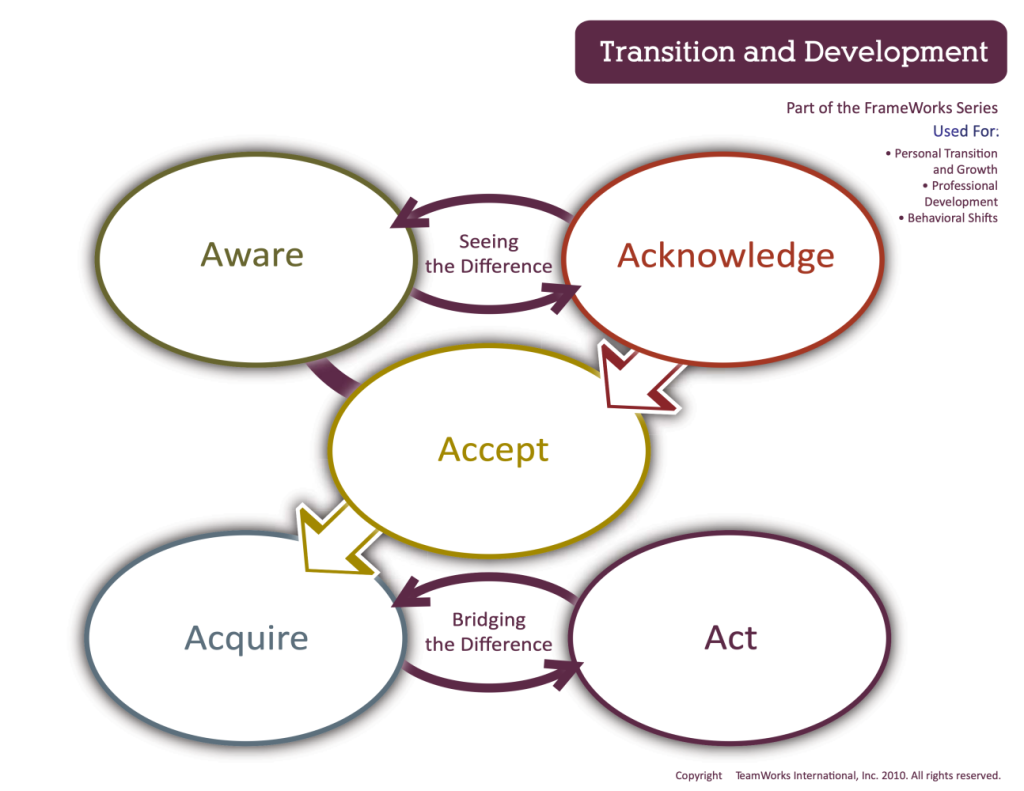
Now you can invest your time strategically rather than generically. The framework shows you exactly what each team and member need next.
A District Example
A mid-sized district introduced a new literacy approach across all buildings. By November, staff division was growing. The superintendent requested coaching. Using the Transition and Development FrameWork, the consultant had each teacher indicate their stage: 70% were still in Awareness and Acknowledgement, while 30% had reached Ability and Action. The pattern revealed two different trainings had created two different levels of understanding. Within 30 days of targeted re-training, the principal reported reduced tension and increased collaboration.
Practice #3: Trust Before You Manage – Build Competence Through Demonstration
Trust doesn’t emerge from inspiring speeches. Trust forms when people see you demonstrate competence and reliability consistently over time.
Research on distributed leadership found cognitive trust (based on competence and reliability) forms faster than emotional trust in task-focused interactions.3 People assess your trustworthiness through five criteria: competence, reliability, sincerity, integrity, and benevolence.
This creates a paradox. Partnership requires trust. Trust requires demonstration of competence first. The sequence matters: manage well, build trust, then partner effectively.
Management done well looks simple. You’re fair, consistent, timely, professional. You follow through. You communicate clearly. You handle crises without panic. This isn’t flashy leadership. It’s foundational. It’s the base layer that makes everything else possible.
The superintendents everyone trusts didn’t earn that trust through charisma. They earned it by demonstrating competence daily. They showed up. They delivered. They were reliable. Over time, consistency created the foundation for partnership.
Bypass this foundational work and resistance will surface. Not because people are unwilling, but because they are wise. They’ve learned to be cautious with leaders who haven’t yet shown consistency and follow-through.
Practice #4: Share the Authority – Distribute Leadership Across Your System
Partnership isn’t delegation with a different label. Partnership means you’re genuinely willing to walk away from your own solution if the deliberative process produces something better.
This is where most leaders get stuck. You ask for input. Your team provides thoughtful alternatives. Then you implement your original plan anyway because, deep down, you never really intended to change course.
Research across multiple studies demonstrates that leadership development programs focusing on building organizational capacity (not just individual skills) produce significantly better outcomes, with participants reporting enhanced collaboration, increased job satisfaction, and measurable improvements in organizational performance.4
True partnership requires distributing authority across the system. This doesn’t mean everyone has equal authority. That’s neither realistic nor desirable. But it does mean creating legitimate pathways for leadership to emerge at multiple levels.
Identify three decisions coming up in the next quarter. For each one, map out who has what type of authority. Who will ultimately choose? Who must be consulted? Who needs to be informed? Be explicit. Put it in writing. Share it broadly.
Then honor it.
When the consultation process produces a recommendation different from your initial thinking, you have a choice. If their solution is clearly superior, you champion it as much as you would your own. If it’s not clearly superior but falls within the acceptable range you defined, you still champion it. Partnership means owning decisions you didn’t think of.
This is uncomfortable. It requires letting go of control. It demands trust that others can carry their weight. It means accepting that the organization might not implement your solution.
But here’s what you gain: creativity and innovation you couldn’t generate alone, ownership from people who helped create the solution, capacity that continues growing even when you’re not in the room, and a culture where leadership is a shared capacity rather than a rare commodity.
The research is clear: distributed leadership approaches enhance self-efficacy, strengthen culture, and correlate with improved student outcomes.5 The benefits aren’t theoretical. They’re measurable and significant.
Distribute authority intentionally. Create structures that support shared leadership. Then get out of the way and watch capacity multiply.
The Clarity That Changes Everything
These four practices work together. Partner most of the time to build capacity. Use frameworks to create shared language. Demonstrate competence to build trust. Distribute authority to create sustainable capacity.
None of this requires additional budget. All of it requires intentional choices about how you invest your time.
Organizations seeing stronger results aren’t doing anything magical. They’re doing something methodical. They’ve committed to building leadership capacity strategically rather than hoping it emerges from individual training events.
January offers a unique window. New calendar. Fresh priorities. Time to set direction before the year accelerates beyond your control.
Imagine your district six months from now. Principals bring fully developed solutions. Cabinet members engage in substantive dialogue about real strategic questions. Teachers view themselves as leaders. The board operates with clarity about governance versus management.
The capacity you build this quarter creates momentum for the entire year.
What would become possible in your district if you invested the next 90 days building leadership capacity through partnership rather than simply managing your current reality?
References
- Nadeem, M., “Distributed Leadership in Educational Contexts: A Catalyst for Collaboration,” *International Journal of Educational Leadership* 9, no. 2 (2024): 44-60. ↩︎
- Felipe Senna Cotrim and Jorge Filipe Da Silva Gomes, “Longitudinal Studies of Leadership Development: A Scoping Review,” *Current Psychology* 43 (2024): 29558-29586, https://doi.org/10.1007/s12144-024-06567-4. ↩︎
- Mustafa Abdul-Jabbar, “Building Trust and Accountability Across Distributed Teams,” *International Journal of Project Management* 43, no. 2 (April 2025): 112-128. ↩︎
- “Maximizing the Impact and ROI of Leadership Development: A Theory- and Evidence-Informed Framework,” *Administrative Sciences* 14, no. 10 (October 2024): 1-34, https://doi.org/10.3390/admsci14100245. ↩︎
- Qiong Li et al., “How Distributed Leadership Affects Social and Emotional Competence in Adolescents: The Chain Mediating Role of Student-Centered Instructional Practices and Teacher Self-Efficacy,” *Behavioral Sciences* 14, no. 2 (February 2024): 1-18, https://doi.org/10.3390/bs14020156. ↩︎